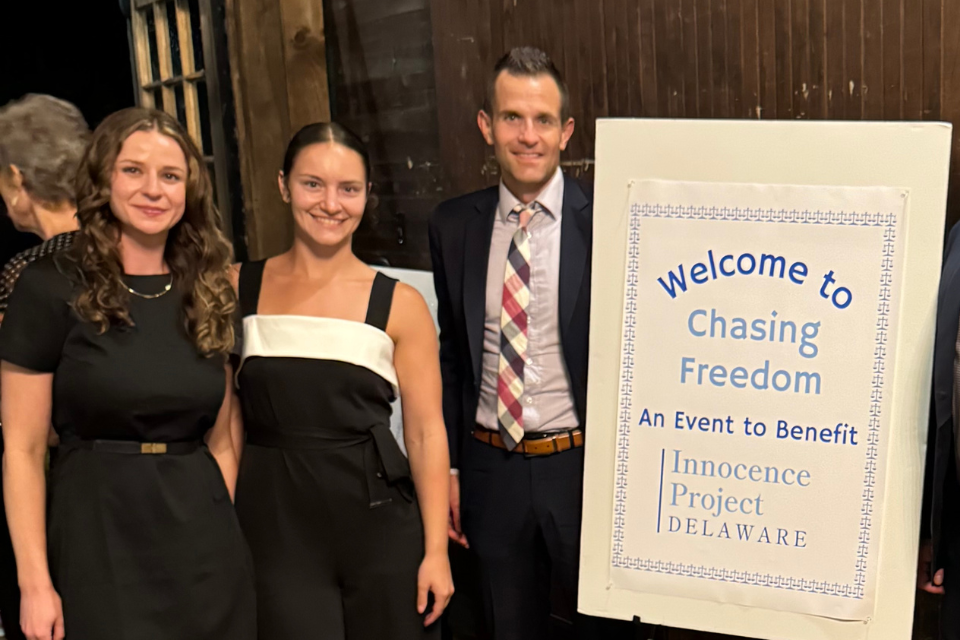
The justice system is built on certainty — verdicts delivered, sentences imposed, cases closed. But when the system gets it wrong, unwinding that mistake is slow, fragile and difficult. Few people see that process up close, and fewer choose to step into it.

Professor Judith Ritter has spent her career in that space. After decades directing the criminal defense clinic at Widener University Delaware Law School, she knew the system didn’t always catch its own errors. She also knew Delaware had no organization dedicated to helping indigent people, often after years of imprisonment, challenge wrongful convictions.
Ritter began meeting with the Delaware Office of Defense Services, the attorney general, and the chief judge of the Delaware Supreme Court. She worked with others to build an advisory board, incorporate an organization and secure a federal wrongful conviction grant that led to the creation of Innocence Project Delaware. Funding allowed the nonprofit to hire its first executive director and an investigator.
The project launched in 2018, and a companion clinic opened at the law school soon after.
Through it all, what emerged was not just a nonprofit. It was a first for the state of Delaware, a place where students could confront firsthand one of the hardest truths in law: Sometimes the system is wrong, and correcting it requires meticulous, sustained work.
Inside the Work: Transcripts, Prison Visits and Human Stakes
Law students in the clinic investigate wrongful conviction based on innocence claims. They review trial transcripts, track down records, interview witnesses and meet with incarcerated clients who have few remaining options.
For Annie Sanker, that work reshaped her understanding of justice.
“I don’t think any classroom setting could ever prepare you to go inside a prison and have somebody explain to you or plead with you why they shouldn’t be there,” she said. “The human aspect of it is so invaluable.”
Sanker worked on cases with a partner.
“It’s hard to work on something and then leave it behind,” she said. “But you know you’re doing something good.”
Carolyn Levitz entered law school already interested in innocence work, but the clinic forced her to confront the discomfort of questioning a conviction.
“It’s hard for people to grasp how someone could be innocent if they were convicted,” she said. “But things fall through the cracks.”
Her first prison visit stayed with her.
“Leaving the prison, knowing someone could be sitting there for something they didn’t do — it really puts your life in perspective,” she said.
A Mentor Who’s Seen the System From Every Angle
Dan Signs brings a full-circle perspective to innocence work. He served in an innocence clinic in Michigan when he was in law school, gaining firsthand experience with the complexities of wrongful conviction cases. Early in his legal career he spent about 10 years as a public defender, representing clients whose futures depended on careful, persistent advocacy.
Signs came to Innocence Project Delaware nearly three years ago and now serves as its staff attorney. This past year was his first teaching the Delaware Law innocence project clinic.
His background gives students a mentor who understands both the urgency and patience the work requires.
Why Students Step Toward the Hardest Problems in Law
Ritter has watched students grow into sharper investigators, more empathetic listeners and more confident advocates. She said the clinic appeals to prospective students because it offers direct engagement with the justice system’s hardest problems.
“Students want to do work that matters,” Ritter said. “And it’s hard for anyone to argue that it’s OK for innocent people to be serving life.”
Innocence Project Delaware has participated in one exoneration, is investigating approximately 40 cases and has six current clients.
The work demands humility, the willingness to acknowledge when the system failed and the courage to help repair it. For Delaware Law students, that courage often begins in the clinic. For some, it becomes a calling.
And for the next generation, the invitation is clear:
Step into the hard work.
Step into the uncertainty.
Step into the places where the system resists being corrected.
Because justice doesn’t defend itself — people do.
Learn more about the Innocence Project Delaware Legal Clinic.