
Delaware Law Alumnus Sparks Civic, Constitutional, and Community Dialogue in Immersive Campus Event
2/18/2026
Delaware Law welcomed alumnus Kyle Bowser back to campus for an immersive evening that blended film, constitutional analysis, and community dialogue.
Bowser, a 1991 graduate, is an entertainment executive, producer, and creator of the Trial by Jury series, which blends legal analysis with narrative storytelling to spark civic dialogue. Over his career, he has worked across film, television, and public engagement initiatives, using media as a tool to explore complex social and constitutional issues.
“I greatly appreciate the opportunity to return to Delaware Law School to offer an innovative approach toward analyzing the precepts and consequences of social policy. What remains unresolved is the means by which we identify those with fully vested entitlement to the promise of America. Trial by Jury endeavors to probe that question,” Bowser said.
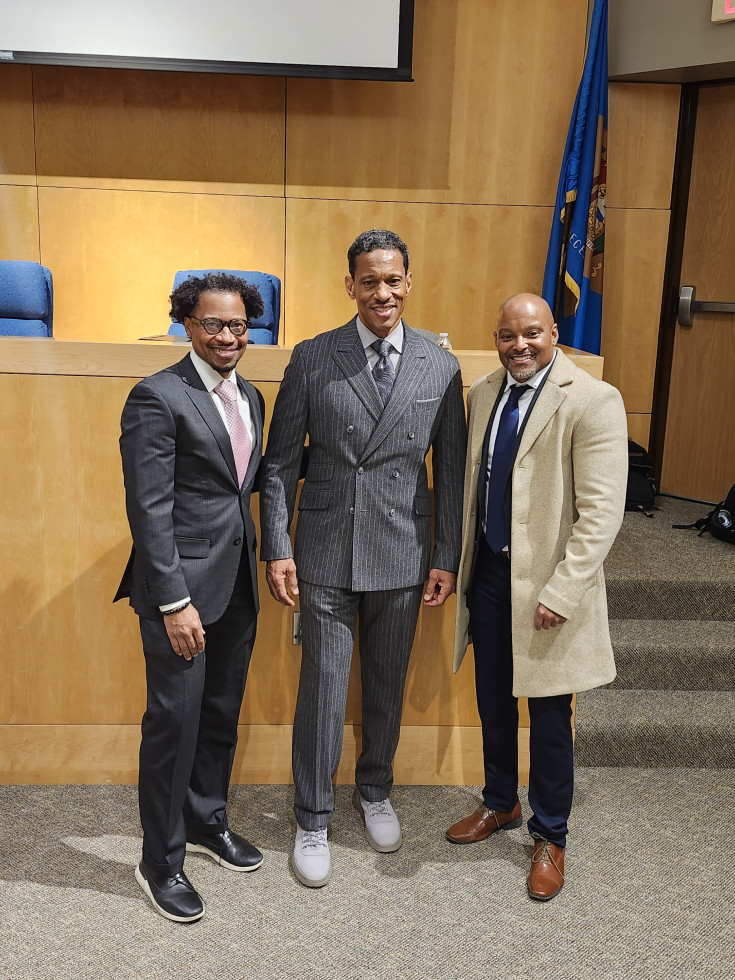
(L to R) Joseph Farris, Kyle Bowser, and Dean Todd Clark
Bowser’s visit reflects Delaware Law’s commitment to preparing lawyers who can navigate the legal, social, and human dimensions of contemporary issues. According to Joseph Farris, associate dean of Student Academic Affairs, Inclusion, and Belonging, programs like this extend learning beyond the classroom and strengthen Delaware Law’s culture of community and connection.
The interactive and well-attended event, co-sponsored by the Student Bar Association, Latin American Law Student Association, and Black Law Student Association, screened Trial by Jury: A Case of Deportation. The 30‑minute film, one of three installments in Bowser’s series, immediately immersed viewers in the emotional and legal stakes of a young man facing deportation. The narrative’s structure, grounded in real‑world constitutional questions, set the stage for a conversation that would stretch far beyond the film itself.
The film’s storyline created a natural entry point for examining the law from multiple angles. Students and faculty unpacked the constitutional issues embedded in the narrative, including the First, Fourth, and Fourteenth Amendments, while also confronting the challenges of applying centuries‑old legal language to modern realities.
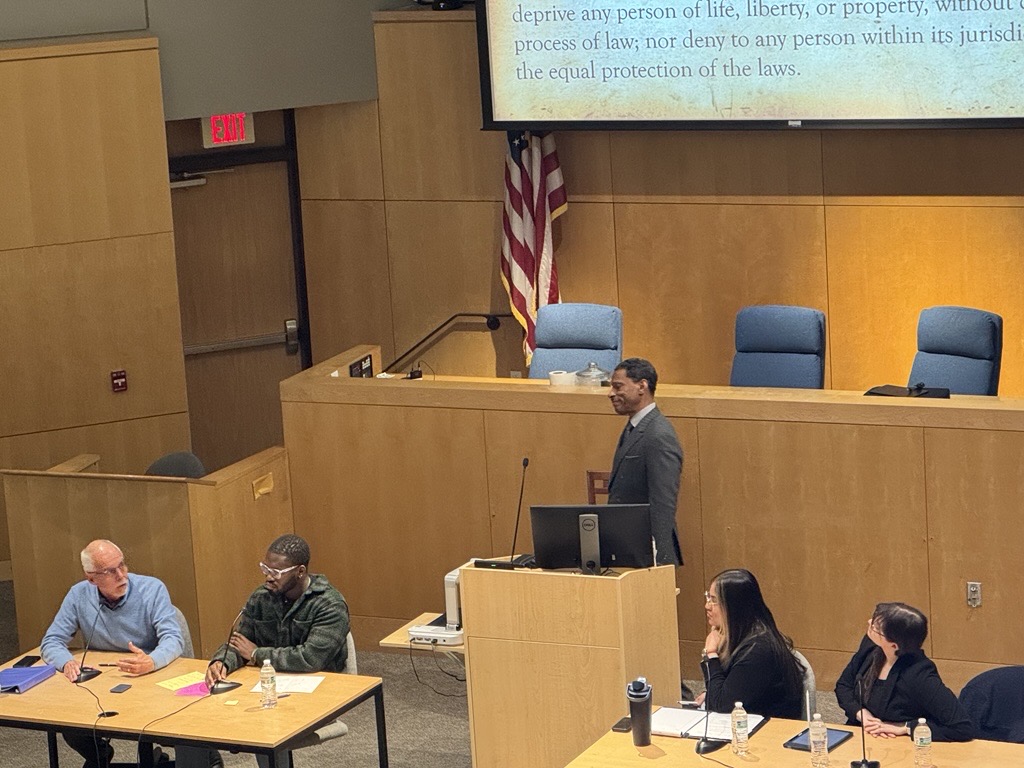
Pictured left to right: Associate Dean for Faculty Development and Professor of Law John Culhane, Nana Amoah-Mensah, Kyle Bowser, Avery Pissani, and Paola Arredondo Cardenas
A curated group of panelists guided the discussion with Bowser. Professor Alan Garfield’s influence surfaced as well, particularly his reflections on the contradiction between Emma Lazarus’s welcoming vision of America, “Give me your tired, your poor, your huddled masses yearning to breathe free,” and the nation’s long history of cultural boundary-making.
“At this intensely partisan moment in our nation’s history, programs like this are critical,” Garfield said. “They help rebuild a sense of unity and shared purpose that our country desperately needs.”
The structure of the evening, beginning with personal connection, moving into shared viewing, and culminating in open dialogue, created an ideal, community-centered environment for exploring the case from multiple perspectives. Students noted how the experience helped them see the human story behind the legal arguments and understand how different communities might interpret the same facts through different lenses.
“The discussion about what it means to be ‘American’ really stayed with me,” said 3L Sharice Bland. “Seeing America framed as a brand was something I’d never considered, and it made perfect sense. It pushed me to think differently about identity, dignity, and how people view DACA and undocumented immigrants.”
“The event was refreshing,” said Darlene Williams, a 2016 alumna of the Graduate, International, Compliance and Legal Studies program with a certificate in regulatory analysis and compliance. “It showed how real‑world applications, expanding networks, and personal growth continue long after graduation. As a mentor, it reminded me how important it is for alumni to help students navigate their trajectories and build community—not just connections.”
The event also welcomed members of the community, including Senator Elizabeth “Tizzy” Lockman and Akima A. Brown, members of the Delaware Motion Picture and Television Development Film Commission. Brown, also the founder of Reel Families for Change, said this about the event: “Delaware’s film community needs more work like this—storytelling that builds bridges and sparks critical dialogue. Kyle’s presentation did exactly that. Honestly, I expect nothing less from him.”
As the event concluded, the courtroom remained filled with conversation. Students lingered in small groups, still debating constitutional interpretations, ethical tensions, and the lived realities behind immigration law. The evening underscored Delaware Law’s ongoing commitment to creating spaces where students, alumni, and community members can engage deeply with the legal and human issues shaping today’s world.